 Skip to content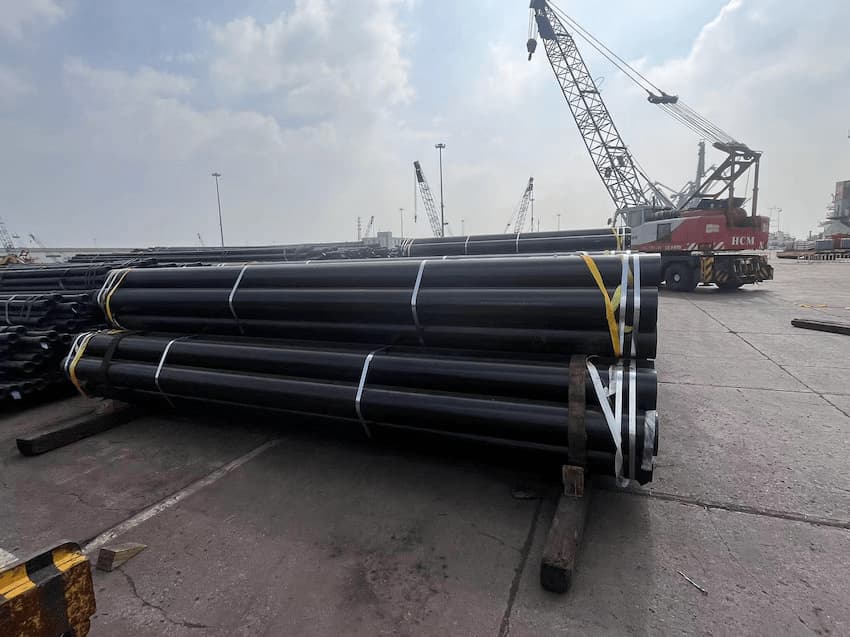
Description
Overview of API 5L X70 Steel
API 5L X70 is a high-strength, low-alloy steel grade used for manufacturing pipelines in the oil and gas industry. It offers excellent mechanical properties and durability, making it suitable for demanding applications in pipeline transportation systems
Chemical Composition and Mechanical Properties
API 5L X70 steel has a carefully controlled chemical composition to achieve its desired properties. The maximum carbon content is 0.17%, with manganese content up to 1.75%. It also contains small amounts of alloying elements such as vanadium, niobium, and titanium
Table: API 5L X70 Pipe Specifications
| Property | Value |
|---|---|
| Yield Strength | ≥485 MPa (70,300 psi) |
| Tensile Strength | 570-760 MPa (82,700-110,200 psi) |
| Elongation | ≥17% |
| Carbon Content (max) | 0.17% |
| Manganese Content (max) | 1.75% |
| Phosphorus Content (max) | 0.020% |
| Sulfur Content (max) | 0.010% |
Manufacturing Process
API 5L X70 pipes can be manufactured using various processes:
- Seamless: Hot rolling or cold drawing
- Welded: Electric Resistance Welding (ERW) or Submerged Arc Welding (SAW)
The manufacturing process involves careful control of heating and cooling cycles to achieve the desired microstructure and mechanical properties
Applications and Advantages
API 5L X70 pipelines are widely used in:
- Oil and gas transmission
- Offshore structures
- High-pressure applications
- Low-temperature environments
Key advantages include high strength-to-weight ratio, excellent toughness, and good weldability
Quality Control and Testing
Rigorous quality control measures are implemented during the manufacturing of API 5L X70 pipes, including:
- Hydrostatic testing
- Non-destructive examinations
- Mechanical property testing
- Chemical composition analysis
Comparison with Other API 5L Grades
API 5L X70 offers higher strength compared to lower grades like X52 or X60, while maintaining good weldability and toughness. It provides a balance between strength and ease of fabrication, making it suitable for a wide range of pipeline applications
People Also Ask(FAQs):
1.What is the difference between API 5L X70 PSL1 and PSL2?
PSL2 has stricter requirements for chemical composition, mechanical properties, and testing compared to PSL1. PSL2 is typically used for more critical applications
2.How does API 5L X70 compare to other grades like X65 or X80?
API 5L X70 has higher yield and tensile strengths compared to X65, but lower than X80. It offers a good balance of strength and weldability
3.What are the main applications of API 5L X70 pipelines?
Main applications include oil and gas transmission pipelines, offshore structures, and high-pressure fluid transportation systems
4.What manufacturing processes are used for API 5L X70 pipes?
API 5L X70 pipes can be manufactured using seamless (hot rolling or cold drawing) or welded (ERW, SAW) processes
5.What are the key advantages of using API 5L X70 steel for pipelines?
Key advantages include high strength-to-weight ratio, excellent toughness, good weldability, and suitability for high-pressure and low-temperature applications


Reviews
There are no reviews yet.