 Skip to content
Description
Chemical Composition and Mechanical Properties of Austenitic 321 (S32100) Stainless Steel
Chemical Composition:
| Element | Percentage |
|---|---|
| Carbon (max) | 0.08 |
| Manganese (max) | 2.00 |
| Silicon (max) | 0.75 |
| Chromium | 17.00-19.00 |
| Nickel | 9.00-12.00 |
| Titanium | 0.70 |
Mechanical Properties:
| Property | Value |
|---|---|
| Tensile Strength (min) | 75 ksi (515 MPa) |
| Yield Strength (min) | 30 ksi (205 MPa) |
| Elongation (min) | 40% |
| Hardness (max) | 95 HRB |
Applications and Industries Using 321 Stainless Steel Plates and Coils
321 stainless steel is widely used in:
- Aerospace Industry: Aircraft exhaust systems and engine parts
- Chemical Processing Equipment: Heat exchangers, pressure vessels, and storage tanks
- Thermal Equipment: Boilers, furnace parts, and industrial heat-treating equipment
- Petroleum and Refining Industry: Piping and refining equipment
- Automotive Industry: Exhaust systems and components exposed to high temperatures
- Marine and Shipbuilding
- Food Industry
- Nuclear Engineering
Manufacturing Process and Available Dimensions
Manufacturing Process: Hot rolled or cold rolled
Available Dimensions:
| Dimension | Range |
|---|---|
| Thickness | 0.3 – 80 mm |
| Width | 1000 – 2200 mm |
| Length | 2438 – 12000 mm |
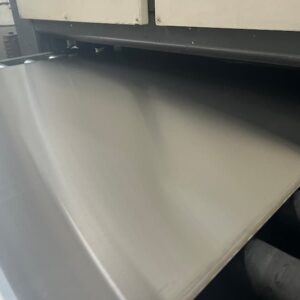
Surface Finish Options: No.1, 2B, BA, MATT, PVC coated, No.4, No.5, SB, HR, No.8, Mirror, Hairline, Brush, Textured
Corrosion Resistance and High-Temperature Performance
321 stainless steel offers excellent resistance to intergranular corrosion due to its titanium stabilization. It can withstand temperatures up to 900°C (1652°F), making it suitable for high-temperature applications where 304 is typically used up to 500°C (932°F).
Welding and Fabrication Considerations
321 stainless steel has excellent welding characteristics. It can be welded using all fusion and resistance welding processes. No preheating is required, and post-weld annealing is generally unnecessary.
Comparison of 321 with Other Austenitic Stainless Steel Grades
321 is similar to 304 but with added titanium for improved corrosion resistance and high-temperature performance. It offers better resistance to sensitization during welding and prolonged exposure to high temperatures compared to 304.
Reviews
There are no reviews yet.